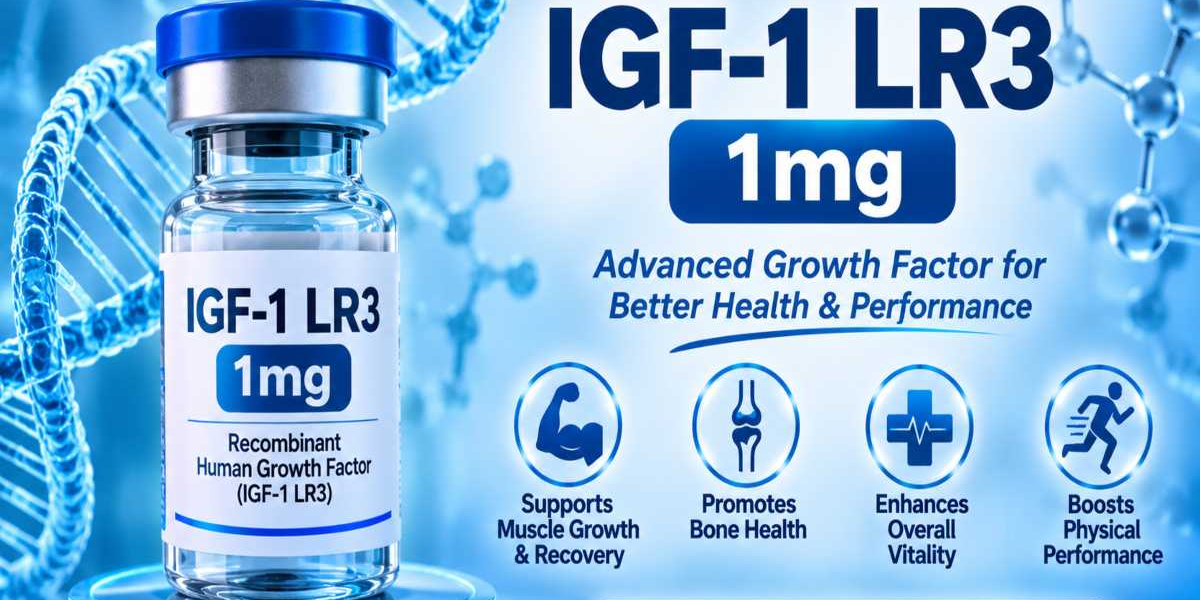

Students often ask what a vial labelled igf-1 lr3 1mg actually contains. It is a lab-grade growth factor analogue sold strictly for research use. This guide explains its structure, quality markers, and handling basics in simple language. Everything here is educational and is not medical advice.
What Is IGF-1 LR3?
IGF-1 LR3 is a modified version of insulin-like growth factor 1, a natural protein hormone studied in cell biology. Researchers who order a 1mg igf 1 lr3 vial receive a freeze-dried powder meant for laboratory work only. The “LR3” label stands for “Long Arg3,” which describes two structural changes made to the original molecule. It is not approved by the FDA for human use.
Short Answer for Quick Readers
IGF-1 LR3 is a lab-made, longer-lasting analogue of insulin-like growth factor 1. It has 83 amino acids and a molecular weight near 9.1 kDa. It is supplied for in-vitro research and is not a medicine.
Structure and How It Differs From Natural IGF-1
Natural IGF-1 has 70 amino acids and is made mainly in the liver after growth hormone signals. LR3 swaps the third amino acid, glutamic acid, for arginine, and adds a 13-amino-acid extension at the start. These edits reduce binding to IGF-binding proteins, so more of the molecule stays free in a culture dish. Think of it like a key that stays in your pocket instead of being locked away in a drawer.
Why Half-Life Matters in the Lab
Native IGF-1 is cleared fast, often within minutes in its free form. In reports about igf 1 lr3 1mg material, the half-life is usually described as many hours. A longer half-life means fewer media changes during a long experiment.
Research Applications and Related Entities
The best-known use is as a growth supplement in cell culture, including media for CHO cells used in biopharmaceutical production. Labs also study the IGF-1 receptor, the PI3K/Akt pathway, and the mTOR signalling network alongside it. Insulin-like growth factor binding proteins, known as IGFBPs, are another core entity in these studies. Papers on these topics are indexed in PubMed by the U.S. National Library of Medicine.
Typical Laboratory Contexts
Cell biologists use the analogue to keep cultures healthy over several days. The goal is to observe how cells grow, divide, and survive under controlled conditions. Common contexts are listed below.
Serum-free media supplementation
Receptor binding assays
Signalling pathway mapping (PI3K/Akt, MAPK)
Interaction studies with IGFBPs
Quality Markers to Check Before Buying
When you evaluate igf-1 lr3 1mg, start by asking whether the supplier shares a certificate of analysis for every batch. Look for HPLC purity commonly at or above 98 percent, plus mass spectrometry that confirms the molecular weight. Buyers who search for 1mg igf-1 lr3 should also check batch numbers, endotoxin notes, and storage details. Poor documentation is a warning sign, just as a student would doubt a test paper with no teacher’s signature.
Storage and Handling Basics
Freeze-dried vials are normally kept cold, dry, and away from light, as the supplier’s label directs. Repeated warming and cooling can damage a protein, so labs log every handling step. Always follow your institution’s safety rules and the product documentation.
Red Flags to Avoid
Weak listings often look polished but hide basic facts. Compare every seller against the signs below.
No batch-specific certificate of analysis
Missing “research use only” labelling
Claims about health benefits or personal results
A Simple Classroom Example
Imagine, as a hypothetical case, a student named Ayesha who runs a week-long cell culture project in a university lab. Her supervisor hands her a sealed 1mg igf 1 lr3 vial together with its batch report. She records the lot number, storage temperature, and every handling step in her notebook. This habit shows why research using igf-1 lr3 1mg stays repeatable and trustworthy.
Legal, Safety, and Ethical Notes
IGF-1 LR3 is sold as a research chemical, not as a drug or dietary supplement. Any listing for igf 1 lr3 1mg should say clearly that it is not approved by the FDA for human or veterinary use. The World Anti-Doping Agency lists IGF-1 and its analogues on its Prohibited List, so athletes must avoid them. Anyone with health questions should speak with a licensed doctor instead of relying on online articles.
Final Takeaways
IGF-1 LR3 is a stable, long-acting growth factor analogue designed for laboratory research. Anyone comparing 1mg igf-1 lr3 products should put documentation, purity data, and compliance first. Good science depends on clear records, honest labels, and careful reading of credible sources. Disclaimer: for research use only, not for human use, and not intended to diagnose, treat, cure, or prevent any disease.
Frequently Asked Questions
What does LR3 stand for?
LR3 means “Long Arg3.” It points to the arginine swap at position three and the extra 13-amino-acid chain at the start. Together, these changes make the molecule behave differently from natural IGF-1.
Is IGF-1 LR3 approved for people?
No, it is not approved by the FDA for human use. It is sold only as a laboratory research material. Medical questions belong with a licensed doctor.
Why does it last longer than natural IGF-1?
It binds less tightly to IGF-binding proteins. That leaves more of it free and slower to clear in a culture system. This is why researchers often describe it as longer-acting.
What purity should researchers look for?
Many labs look for HPLC purity at or above 98 percent. They also want mass spectrometry data that matches the expected molecular weight. A batch-specific certificate of analysis should always back these numbers.