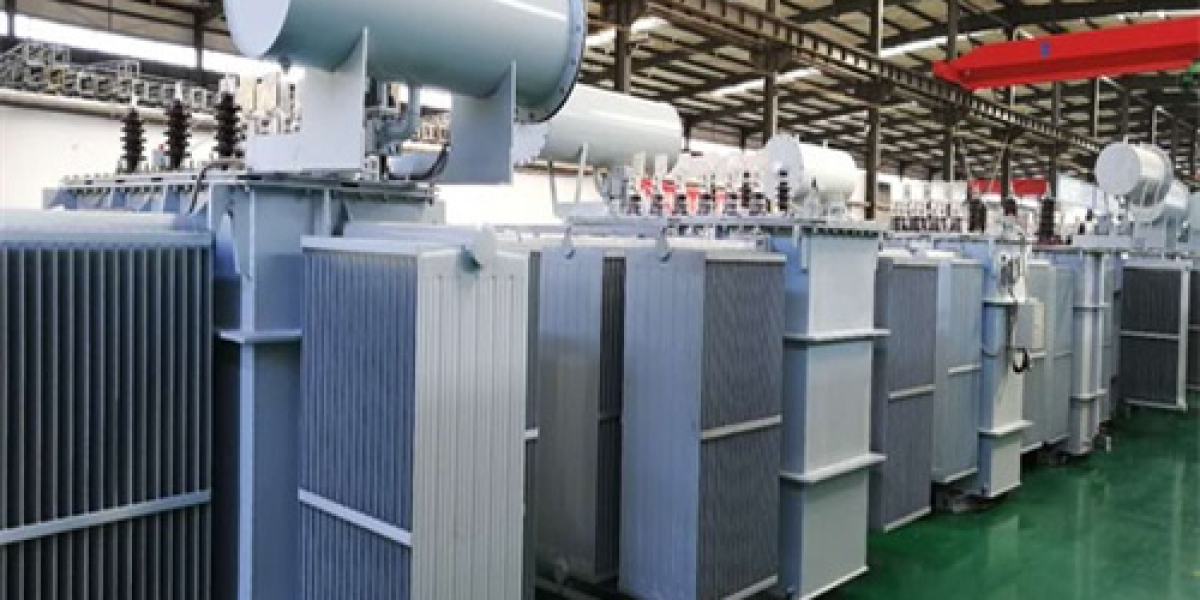

The S20 oil-immersed transformer carries a fixed oil volume engineered into the tank — enough to fully submerge the windings with margin for thermal expansion, but not so much that heated oil has nowhere to go. The exact quantity comes from the tank design, cooling class, and whether the unit is sealed or breathes through a conservator. You don't choose it in the field; the factory sets it, and your job is to keep it in range.
1. What the oil is actually doing in there
Insulating oil in an S20 does four jobs at once. It electrically insulates the windings and leads, it moves heat from the core and coils to the tank wall by convection, it fills voids so there's no air to ionize, and it acts as a built-in condition monitor — dissolved gas and moisture in the oil tell you what's happening inside long before anything fails. Cut the oil volume short and you lose all four at once.
2. How the oil quantity gets set
The factory sizes the oil volume from the tank geometry, not from a per-kVA table. Capacity, rated voltage, cooling class (ONAN, ONAF, OFAF), and whether the design is sealed (hermetic, corrugated tank, no conservator) or free-breathing (separate conservator) all move the number. [Confirm: the exact oil volume for your specific S20 is on the nameplate and in the factory outline drawing — see the oil-immersed range on our products page.] The target is to keep every energized surface submerged across the full operating temperature range, with headroom so expansion doesn't push oil out the relief path.
Design factor | Why it changes the oil volume |
|---|---|
Tank geometry & clearances | Sets the physical space the oil has to fill |
Cooling class (ONAN / ONAF / OFAF) | Forced cooling changes flow paths and thermal margin |
Sealed vs conservator | Sealed tanks need tighter free volume; conservators absorb expansion |
Operating temperature range | Hot oil expands; the level must stay in band at both ends |
See the full oil-immersed catalog here: products page
3. Too little oil vs too much
Both ends of the range cause trouble, just differently.
- Low oil exposes windings and tap changer to air. Moisture and oxygen get in, dielectric strength drops, and you lose convective cooling right where the heat is generated. Left alone, this is how you get a winding fault.
- Overfilled oil has no room to expand as it heats. It forces the pressure-relief device, pushes past seals, or overfills the conservator so it spills on the next warm day. Neither scenario is harmless.
The "right" amount is the band marked on the level gauge, not "as full as possible."
4. Reading the oil level the right way
This is where most field mistakes happen. The sight glass or level gauge is calibrated for a reference temperature — often a "cold" or 25 °C mark and a "hot" mark — because oil volume changes with temperature. Read it when the unit is at its normal operating temperature, or correct for temperature if you're filling cold. Filling to the very top of the gauge on a cold morning means the oil will be over the mark once it warms up.
We cover oil testing and dissolved-gas analysis in more depth across the resources library.
5. In-service checks and top-up
For a unit already in service, oil handling is routine maintenance, not an emergency response:
- Inspect the sight glass at each scheduled inspection; note the level against the temperature-correct mark.
- Look for leaks at gaskets, welds, bushings, and the radiator joints — oil loss is almost always a leak, not consumption.
- Run dissolved gas analysis (DGA) on a schedule per IEEE C57.104 / IEC 60599; trend it, don't just snapshot it.
- Check moisture and dielectric breakdown voltage (ASTM D877 / D1816, IEEE C57.106) when the oil looks suspect.
- Keep the tank closed and the breather (if fitted) desiccant active; moisture and particulates are the enemies of both insulation and oil life.
Oil quantity and cooling class also drive the load losses you'll pay for over the unit's life — estimate them with our transformer loss and TCO calculator.
6. What oil to put back in
Top-up and replacement have to match what's already in the tank. New mineral oil for liquid-filled power transformers is specified by ASTM D3487 (Type II for most units) or IEC 60296; natural and synthetic esters are covered by ASTM D6871 and IEC 62770 / IEC 61099 respectively. Don't mix mineral oil with ester fluid — they don't, and the result can wreck the paper insulation. [Confirm: the fluid type and any inhibitor or finish specification for your S20 before ordering.] When you're specifying fluid or a supplier, our power transformer manufacturers and suppliers guide covers what to look for.
7. Environmental and waste handling
Used transformer oil is a regulated waste in most jurisdictions, and a spill is a reportable event, not a mop-up. Secondary containment (a curbed pad or berm) and a spill kit belong wherever a liquid-filled unit sits — the same SPCC thinking that governs bulk oil storage. Recycling used oil through a licensed handler is the default; burning or dumping it isn't. Eco-friendly esters (higher fire point, biodegradable) are worth considering where fire risk or environmental sensitivity is the deciding factor, though they change the maintenance and compatibility rules, so plan for them up front.
For the installation-side rules — fire separation, ventilation, and containment — run our NEC transformer calculator.
8. FAQ
How much oil is in an S20 transformer?
It isn't a single published number per kVA — the volume is set by the tank design, cooling class, and sealed-vs-conservator choice for that specific unit. The nameplate and the factory outline drawing give the exact figure for your unit. As a rough sense, the oil is a sizable fraction of the shipped weight, but treat the drawing as the answer, not a rule of thumb.
What actually happens if the oil level drops too low?
Exposed windings lose their insulation margin and their convective cooling at the same time, and air in the tank pulls in moisture that degrades the paper and the dielectric strength. That's a direct path to an internal fault. Low level almost always means a leak, so find and fix the leak rather than just topping up.
Can I just fill it to the top of the gauge?
No. The gauge has cold and hot marks because oil expands as it warms. Filling to the top cold means it will be over the mark — and possibly out the relief — once the unit is at load. Fill to the cold mark (or the temperature-corrected mark for your conditions) and leave the expansion room.
How do I read the level gauge correctly?
Read it at the unit's normal operating temperature, or correct for temperature if you're checking it cold. The reference marks are on the gauge plate or nameplate. A level that looks "low" on a cold morning can be perfectly normal.
How often should I check the oil?
At every scheduled visual inspection for level and leaks, with dissolved-gas analysis and moisture/breakdown-voltage testing on a periodic schedule per IEEE C57.93 / C57.104 and your site's maintenance plan. Trend the tests over time; a single reading tells you less than the direction it's moving.
What oil do I buy to top up or replace?
Match the existing fluid exactly. New mineral oil is ASTM D3487 (Type II) or IEC 60296; esters are ASTM D6871 / IEC 62770 or IEC 61099. Never mix mineral oil with ester.
Is used transformer oil hazardous waste?
In most places, yes — it's a regulated waste that has to go to a licensed recycler, and a spill is a reportable event. Keep secondary containment and a spill kit at the site, and never burn or dump it.
Does a sealed tank hold more or less oil than one with a conservator?
Neither more nor less in a useful sense — the sealed (hermetic, corrugated) design has less free expansion volume, so the oil quantity and the allowable level band are tighter and the unit relies on the tank wall to absorb expansion. A conservator unit carries extra oil in the conservator to absorb that expansion. The right volume is whatever the drawing specifies for that design.