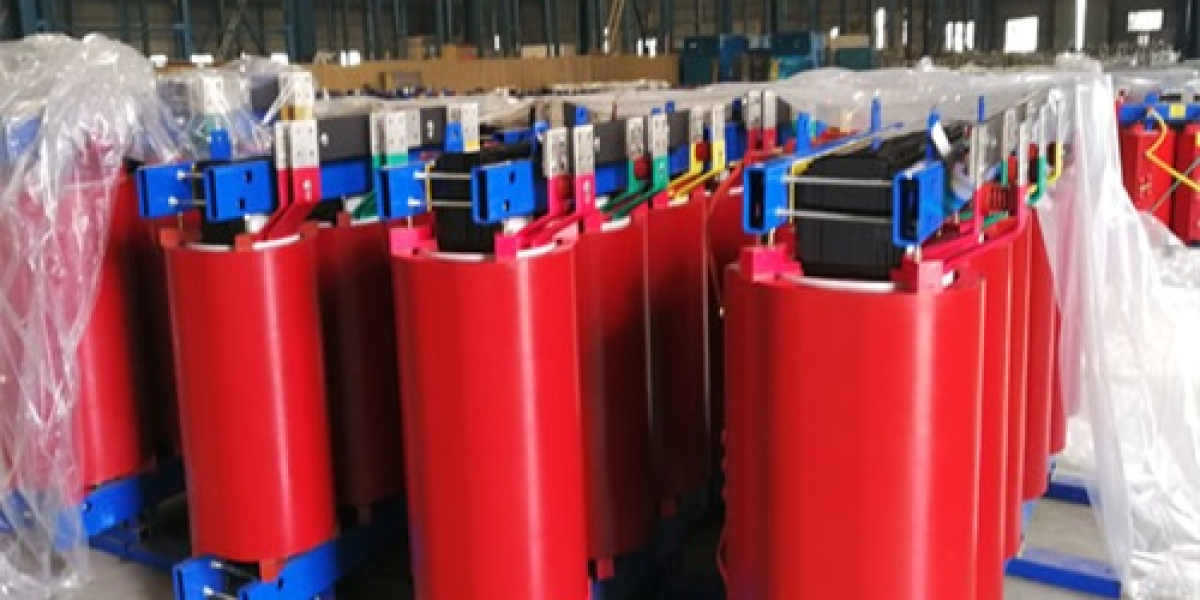

Dry-type transformers need a fire separation distance from buildings and other equipment so a fault or fire can't spread to nearby combustibles. In the U.S. the rule that matters is NEC 450.21: units above 112.5 kVA must keep 12 in (305 mm) of clear space from combustible material or sit behind a fire-rated barrier. Chinese codes take a different route, setting building setbacks by capacity — 8 m horizontally and 4 m vertically above 630 kVA, 5 m and 3 m below.
1. What "fire separation distance" actually means
The fire separation distance is the minimum clear gap between a dry-type transformer and the buildings, structures, or other equipment around it. The point is to keep flame, radiant heat, and smoke from reaching something that burns. People sometimes treat dry-type units as fireproof because there's no oil, but the insulation, varnish, and enclosure materials still ignite under fault conditions, so the gap matters.
Most dry-type transformers use a delta-wye (Dyn) winding, which our delta-wye explainer walks through. They're also common as isolation transformers, and the same clearance logic applies whichever role they play.
2. The two rule sets you'll run into
If you're working from a Chinese spec, you'll see capacity-based building setbacks. If you're installing in the U.S., you'll see clearance-to-combustible rules under NEC 450.21. They answer different questions, which is why the numbers don't line up.
Condition | Chinese code values (source) | U.S. reference |
|---|---|---|
Unit ≥ 630 kVA | Horizontal ≥ 8 m, vertical ≥ 4 m to buildings | NEC 450.21(B): 12 in (305 mm) clear of combustibles or 1-hour fire barrier |
Unit < 630 kVA | Horizontal ≥ 5 m, vertical ≥ 3 m to buildings | Same rule; threshold is 112.5 kVA, not 630 kVA |
Citations | [Confirm: cite the specific GB article — likely GB 50016 or GB 50229; verify edition] |
|
The 630 kVA threshold in the Chinese values is a different regulatory line than the 112.5 kVA threshold in NEC 450.21. One is a building-setback framework; the other is a clearance-from-combustibles framework. Don't try to map them one-to-one — treat them as two separate compliance paths.
3. How the spacing gets set: safety, cost, and code
Three things pull the number in opposite directions:
- Safety — the gap has to be wide enough that a fire at the transformer doesn't reach the building or the next unit. This pushes the distance up.
- Cost — a bigger setback means more land, longer cable runs, and a larger enclosure. This pushes it down.
- Code — the applicable code sets the floor. You can always go wider than the minimum; you can't go narrower.
The right answer is the smallest distance that still clears the code and the site's fire risk, not the largest distance the budget can tolerate.
4. When the gap isn't enough: fire-rated walls and barriers
Sometimes you can't achieve the full separation — two units sit close, or the transformer is near a wall. The source's fix is a fire-rated partition wall between adjacent dry-type transformers, or a partition wall topped with a water curtain.
In U.S. practice the equivalent is a fire-rated barrier — a 1-hour fire-resistance-rated wall or assembly per NEC 450.21(B) — placed between the transformer and the combustible surface. A water curtain is a specialized fire-suppression option, not the default; it shows up in engineered systems where a solid barrier isn't practical. The barrier does the same job as the open gap: it stops heat and flame from crossing to the other side.
5. Outdoor units and the firewall rule
For an outdoor dry-type transformer, the source says that when the plant exterior wall sits closer to the unit than the code table allows, that wall has to be a fire wall, and the wall must stay at least 0.8 m from the transformer's outer edge. The 0.8 m is Chinese practice.
In the U.S. the same situation is handled through NEC 450.21 together with the local building and fire code (often the IBC and the authority having jurisdiction). The practical outcome is the same: a fire-rated wall between the transformer and the occupied space, with a defined clearance. Confirm the exact dimension with the engineer of record rather than carrying the 0.8 m across from a Chinese spec.
6. What the U.S. side actually requires
NEC Article 450 splits the spacing rules by transformer size:
- 450.21(A) — general requirements for all transformers.
- 450.21(B) — transformers rated over 112.5 kVA must be separated from combustible materials by at least 12 in (305 mm) of clear space, or by a fire-resistant barrier.
- 450.21(C) — transformers rated 112.5 kVA or less have lighter separation requirements but still can't be mounted against combustibles without protection.
Ventilation (NEC 450.9) and the local fire marshal's reading of the code also enter the picture. Run your specific unit through our NEC transformer calculator to check the spacing and ventilation inputs before you finalize the layout.
7. Spacing checklist
Before the unit is set:
- Confirm the applicable code path — NEC 450.21 for U.S. installs, or the Chinese fire code values for a China-spec project.
- Check the kVA threshold that triggers the stricter rule (112.5 kVA under NEC; 630 kVA under the Chinese values).
- Measure clearance from every combustible surface, not just the nearest wall.
- If the gap is short, specify a 1-hour fire-rated barrier instead of open space.
- For outdoor units near a building wall, confirm the firewall requirement and its minimum distance.
- Have the layout signed off by the engineer of record and the local AHJ.
We cover transformer types and code topics across the resources library, and the dry-type units themselves are listed on the products page.
8. FAQ
How far does a dry-type transformer need to be from a wall?
In the U.S., NEC 450.21(B) requires units above 112.5 kVA to keep 12 in (305 mm) of clear space from combustible material, or to sit behind a 1-hour fire-rated barrier. Below 112.5 kVA the rules are lighter but you still can't mount against combustibles unprotected. Chinese specs use larger building setbacks by capacity instead.
Do the 8 m and 4 m numbers apply in the United States?
No. Those are Chinese fire-code values — 8 m horizontal and 4 m vertical for units at or above 630 kVA, 5 m and 3 m below. The U.S. uses NEC 450.21, which is built around a 12-inch clearance or a fire-rated barrier, with a 112.5 kVA threshold. They're separate compliance paths; don't substitute one for the other.
Does a dry-type transformer even need fire separation?
Yes, but less than an oil-filled unit. Dry-type transformers have no flammable liquid, so the fire risk is lower, yet the winding insulation and enclosure can still burn under a fault. NEC still requires separation or a barrier for units above 112.5 kVA, and the fire marshal can require more.
Can I use a fire-rated barrier instead of open space?
Yes. NEC 450.21(B) explicitly allows a fire-resistant barrier in place of the 12-inch clear space. A 1-hour fire-rated wall between the transformer and the combustible surface satisfies the rule. This is the standard way to install a unit in a tight space.
What about two dry-type transformers next to each other?
When the spacing between adjacent units falls short, the usual fix is a fire-rated partition wall between them. A water curtain on top of the wall is an option in engineered systems but isn't the default. Check the local code and the unit layout before relying on either.
Does the 112.5 kVA threshold depend on how loaded the transformer is?
No. The threshold is the transformer's nameplate rated kVA, not the actual load. A 1500 kVA unit running at 30% load still triggers the 450.21(B) separation rule because the rating, not the load, sets the requirement.
Who approves the final clearance?
The engineer of record validates the layout, and the local Authority Having Jurisdiction — often including the fire marshal — approves it. Local amendments can tighten the NEC minimums, so the final number is whatever your AHJ accepts, not the bare code figure.