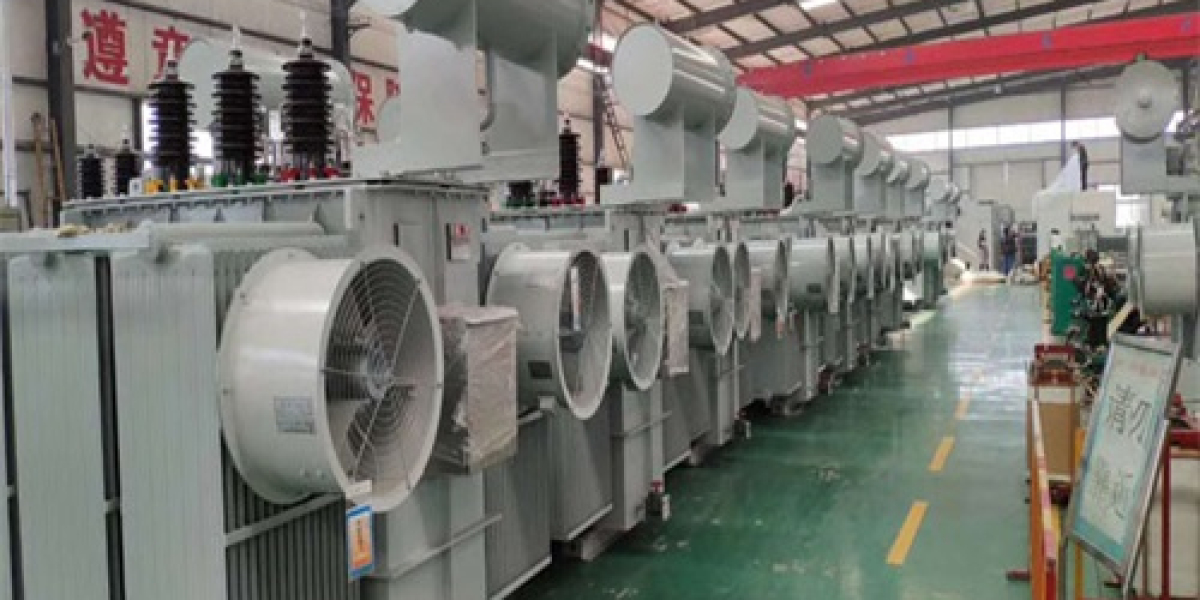

An oil-immersed power transformer is, at heart, a laminated silicon-steel core wrapped with concentric copper or aluminum windings, all sitting in a welded steel tank full of insulating oil that cools the unit while it insulates it. Around that assembly you get the tank fittings — conservator, breather, and gauges — radiators or coolers, the bushings that bring the leads out, a tap changer for voltage adjustment, and protection devices such as the Buchholz relay. Every part pulls weight; none of it is decoration.
1. Core — the magnetic circuit
The core carries the magnetic flux and is built from thin silicon-steel laminations, each coated with an insulating varnish. That coating is what keeps eddy-current and hysteresis losses down; without it the core would heat itself to failure. Two layouts exist: core-type, where the limbs and yokes form a rectangular window with the windings on the limbs, and shell-type, where the core wraps around the windings. Core-type dominates in power transformers because it is simpler to wind and stack, and you can see that layout in the oil-immersed units we build. In larger units the laminations are stacked with vertical oil ducts so the coolant moves through the iron, not just around it.
2. Windings — the electrical circuit
Windings are the current-carrying coils, wound as multilayer cylinders from insulated copper or aluminum conductor. They nest concentrically on the core limb: the lower-voltage winding sits inside, the higher-voltage winding outside, which keeps the insulation distance to the tank wall manageable. The conductor's own insulation — paper, enamel, or resin — separates turns from each other and from ground. This is also where a unit's vector group is set, so it is worth reading up on delta-wye transformer operation before you specify the connection.
3. Tank and its fittings
The tank is the steel shell — welded plate, not cast — that holds the oil and anchors everything else. It is sized for heat dissipation and built to keep weather, dust, and moisture out. Bolted to it are the fittings that keep the oil healthy:
- Conservator (oil reservoir, sometimes called the "oil pillow"): a separate small tank above the main one that absorbs the oil's expansion and contraction and limits the oil's contact with air so it oxidizes more slowly.
- Breather (dehydrating breather): a silica-gel cartridge on the conservator vent that dries the air moving in and out, stopping moisture from reaching the oil.
- Gauges: an oil-temperature indicator and an oil-level gauge so the operator can see the unit is running in range.
4. Cooling system
Losses in the core and windings turn into heat, and that heat has to leave. Radiators or separate coolers connect to the tank so oil convection carries heat from the core out to finned surfaces where it sheds to air. The number of radiators and their surface area scale with the rating and the cooling method — ONAN (natural oil, natural air) up through ONAF and forced arrangements on the bigger units. Coolant classes and rating details are covered in more depth across our resources library. Size the cooling to the worst-case load, not the nameplate average.
5. Bushings
Bushings pass the winding leads through the tank cover while keeping them insulated from the tank wall. They are chosen by voltage class and come as porcelain, oil-filled, gas-filled, or condenser (capacitive) types. Beyond electrical insulation they need mechanical strength and weather resistance, because they are the part most exposed to the outside world — a failed bushing is, in practice, a failed transformer.
6. Tap changer
The tap changer alters the turns ratio by connecting to different tap points on a winding, which shifts the output voltage without changing the incoming supply. Two kinds exist: on-load tap changers (LTC / OLTC) that operate while the transformer is energized, and off-load (de-energized, no-load) tap changers that you can only move with the unit de-energized. A tap changer is what lets a unit track varying load and supply voltage instead of locking you into one ratio — directly relevant when you are weighing a step-up against a step-down unit.
7. Protection devices
To keep a fault from destroying the unit, oil-immersed transformers carry dedicated protection. The Buchholz relay (gas-actuated relay) sits in the pipe between the tank and the conservator; incipient internal faults generate gas that accumulates and, at a set level, trips the breaker. For sudden pressure rises, the pressure-relief device — or the older rupture disc, sometimes called the "explosion vent" — opens to release the tank before it splits. Neither replaces proper relay coordination upstream, but both buy time. How these parts come together on real jobs is in our projects archive.
8. FAQ
What are the main parts of an oil-immersed transformer?
Core, windings, tank and fittings (conservator, breather, gauges), cooling system, bushings, tap changer, and protection devices such as the Buchholz relay. The oil does double duty as both coolant and insulator.
Why is the core made of thin laminated steel?
Because solid iron would waste most of the energy to eddy currents. Thin laminations, each insulated from its neighbor, force the eddy currents into tiny high-resistance loops, and the silicon content lowers hysteresis loss. The result is a core that stays cool enough to do its job.
What does the conservator (oil pillow) actually do?
It gives the oil somewhere to go as it heats and expands and as it cools and contracts, while keeping most of the oil surface sealed from outside air. Less air contact means slower oxidation and longer oil life. The breather dries the small amount of air that still moves in and out.
On-load vs off-load tap changer — which do I need?
If the voltage has to be adjusted while the transformer stays in service, you need an on-load tap changer (OLTC). If adjustments happen only during planned outages, an off-load (de-energized) tap changer is cheaper and simpler. Most utility and industrial units that ride varying supply voltage use OLTC.
Do I need a Buchholz relay on every oil transformer?
It is standard on units with a conservator and enough oil volume to generate a meaningful gas bubble — which is most distribution and power transformers. Small sealed (hermetically sealed, no conservator) units typically rely on a pressure-relief device and upstream protection instead.
Are these designs built for 50 Hz or 60 Hz?
The core is sized for a frequency; a 50 Hz design run on 60 Hz (or vice versa) changes the flux density and can overheat or underperform. If you are importing a unit to North America, confirm the design frequency is 60 Hz, or specify it explicitly.