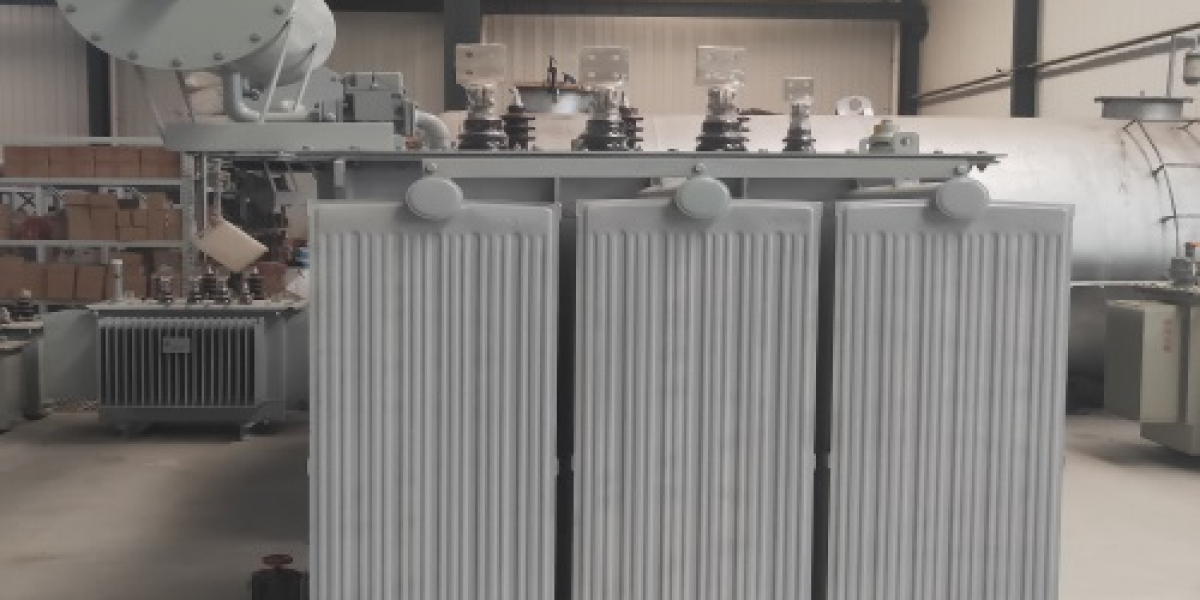

The S20 oil-immersed transformer is a silicon-steel distribution unit rated 80–2500 kVA with primary voltages around 10–35 kV and a 60 Hz variant available on request. It is built to China's GB 20052-2020 Tier 2 efficiency grade and is quoted with roughly 10% lower no-load and load losses than the S13 it replaces. What follows is the specification set buyers actually use to size and compare one.
1. Rated voltage and frequency
The S20 is built for a high-voltage (primary) side and a low-voltage (secondary) side. The nominal voltages quoted for the Chinese market and their North American equivalents are:
Chinese nominal | North American equivalent | Note |
|---|---|---|
10 kV | 12.47 kV / 13.8 kV | Standard U.S. distribution primary |
35 kV | 34.5 kV | Standard U.S. sub-transmission / distribution |
110 kV | 115 kV (or 138 kV) | Outside the distribution class; confirm |
0.4 kV (secondary) | 480Y/277 V | U.S. low-voltage utilization voltage |
The rated frequency is 50 Hz for the domestic grid. A 60 Hz build is available but must be specified at order — core flux density, insulation coordination, and the nameplate are all set for the frequency you order, and the change cannot be made in the field.
The 110 kV entry is worth a pause: an S20 in the 80–2500 kVA range is a distribution transformer, and distribution primaries in that class normally stop at 35 kV. A 110 kV unit points to a larger power-transformer variant, so confirm the exact kVA and impedance before treating it as the same product family. If you are not sure whether your site needs a step-up or a step-down connection, our step-up vs step-down guide lays out the difference.
2. Rated capacity range
The standard S20 ratings run:
Rated capacity (kVA) |
|---|
80, 160, 250, 400, 630, 800, 1000, 1250, 1600, 2000, 2500 |
That 2500 kVA ceiling is not arbitrary for a U.S. buyer. It is also the upper bound of the federal distribution-transformer efficiency mandate: the DOE rules under 10 CFR Part 431 Subpart K cover liquid-filled distribution transformers up to 2500 kVA. Above that line a transformer is treated as a power transformer, and its efficiency is set by the contract, not by federal law. [Confirm which side of that line your unit falls on.] The broader S20 line and other liquid-filled units are listed on our products page.
3. Winding material and coil construction
S20 windings are offered in high-purity electrolytic copper or aluminum. Copper is the default for distribution units because it keeps I²R loss and size down; aluminum shows up where first cost dominates and the thermal and connection details are handled accordingly.
The coil uses a non-circular, concentric arrangement (oval or rectangular cross-section rather than a round coil) that the manufacturer cites for tighter electromagnetic coupling and lower loss. Treat that as a design claim to verify against the test report, not a spec you can read off the nameplate.
4. Cooling method
The S20 is offered with natural cooling and forced cooling:
Cooling class | How it works | When it is used |
|---|---|---|
ONAN | Oil circulates by natural convection; no fans | Base rating, quiet sites |
ONAF / forced | Fans or coolers add airflow to shed more heat | Higher ambient, peak loading |
Natural cooling is labeled ONAN and forced cooling ONAF under the IEC cooling-class codes; both map to the same basic tank, and the forced mode simply lets the unit carry more at higher ambient or during peaks. The relevant U.S. reference is IEEE C57.12.00 for general requirements.
5. Short-circuit impedance
The quoted short-circuit impedance values are 4.0%, 4.5%, or 5.0% depending on rating. Those sit inside the usual 4–6% band for distribution transformers. [Confirm the exact Z% for your kVA.] A higher impedance limits fault current and mechanical stress but also raises voltage drop under load, so the number is a trade, not a "higher is better" figure.
6. Temperature rise
The S20 is quoted with a 60 K top-oil temperature rise, below the 65 K quoted for the S13. Lower rise means more thermal margin before the insulation ages faster. The governing limits are IEC 60076-2 (oil-immersed temperature rise) and, in North America, IEEE C57.12.00 (average winding rise and hotspot limits).
7. Efficiency and energy performance
The S20 meets Tier 2 under GB 20052-2020 (the Chinese minimum energy performance standard). In that three-grade system, Grade 3 is the allowable limit and Grade 2 sits one step above it, so Tier 2 is a genuine efficiency claim, not just market entry. The manufacturer quotes roughly 10% lower no-load loss and 10% lower load loss than the S13.
For a U.S. or export buyer, GB 20052 is not a recognized compliance mark. Check the unit against DOE 10 CFR Part 431 Subpart K §431.197 (liquid-immersed distribution transformers) for the U.S., or EU Ecodesign Regulation 2019/1783 for Europe, and confirm the grade maps to the required tier. [Confirm the target-market compliance.]
A quick ownership-cost check uses the loss formula:
E = P₀ × 8760 + Pₖ × β² × 8760
where β is the load factor. At a blended energy price of [Confirm: e.g. $0.10–0.12/kWh] and an assumed β of [Confirm], the ~10% loss reduction between S13 and S20 becomes a concrete annual kWh saving — but only after you drop in the actual P₀ and Pₖ from the test report. To put real numbers on the saving, use our transformer loss and total-cost calculator. Publish the payback only with those numbers in hand.
8. Enclosure and service environment
The S20 uses a fully enclosed, weatherproof enclosure suited to outdoor duty — rural grid upgrades, remote sites, and non-chemical industrial locations are the typical calls. That enclosure is usually a sealed (conservator-free) tank.
One honest caveat: a sealed tank with no conservator cannot host a Buchholz gas relay, because there is no gas-collecting path above the oil. Protection then rests on a pressure-relief valve, a sudden-pressure relay, and the upstream protection scheme. Do not let "sealed" get sold as "maintenance-free" — the unit still needs oil checks and periodic testing. [Confirm the exact protection and enclosure rating, e.g. IP/NEMA, on the drawing.] We cover enclosure ratings, altitude correction, and site prep in more depth across our resources library.
9. Specification summary
Parameter | S20 value / range |
|---|---|
Rated capacity | 80–2500 kVA |
Primary voltage | 10 / 35 kV (12.47–13.8 / 34.5 kV in North America); 110 kV variant on confirmation |
Secondary voltage | 0.4 kV (480Y/277 V) |
Frequency | 50 Hz; 60 Hz on request |
Winding material | Electrolytic copper or aluminum |
Cooling | ONAN; ONAF / forced on request |
Short-circuit impedance | 4.0 / 4.5 / 5.0% |
Temperature rise | 60 K (top oil), below S13's 65 K |
Efficiency grade | GB 20052-2020 Tier 2 |
Enclosure | Fully enclosed, outdoor-rated, sealed tank option |
10. FAQ
What voltage classes does the S20 cover?
The quoted primaries are 10 kV and 35 kV, with a 110 kV variant listed for larger units; in North America those map to 12.47/13.8 kV, 34.5 kV, and 115/138 kV respectively. The secondary is 0.4 kV, or 480Y/277 V on a U.S. install.
Is the S20 available in 60 Hz for North America?
Yes, on request. Frequency is fixed at the factory — the core and insulation are designed for the ordered frequency — so you must specify 60 Hz when you place the order. It cannot be switched in the field.
Are the windings copper or aluminum?
Both are offered; high-purity electrolytic copper is the standard for distribution units because it keeps loss and size down, and aluminum is the cost-driven alternative. Confirm the material on the nameplate, since it affects loss and connection details.
What does "Tier 2 under GB 20052" mean for a U.S. buyer?
GB 20052 is China's efficiency standard, not a U.S. compliance mark. Tier 2 sits above the Grade 3 minimum, so it is a real efficiency level, but for the U.S. you still verify against DOE 10 CFR 431 Subpart K §431.197, and for Europe against EU Ecodesign 2019/1783.
How much energy does the S20 save versus the S13?
The manufacturer quotes about 10% lower no-load loss and 10% lower load loss. That is a design claim; the actual numbers depend on kVA and must come from the type-test report. Use the loss formula in section 7 to turn the gap into an annual kWh figure.
Does the sealed enclosure need a Buchholz relay?
No. A sealed, conservator-free tank has no gas path for a Buchholz relay to read, so protection uses a pressure-relief valve, a sudden-pressure relay, and upstream protection instead. "Sealed" reduces maintenance but does not remove it.
What short-circuit impedance should I specify?
The standard values are 4.0%, 4.5%, and 5.0%. Pick based on your fault level and allowable voltage drop: higher Z limits fault current but increases drop under load.
What do I need to send to get a quotation?
KVA rating, primary and secondary voltage, frequency (state 60 Hz for North America), vector group, cooling class, service altitude and ambient, and the environment (indoor/outdoor, corrosive, etc.). The more specific the input, the less the factory has to assume.