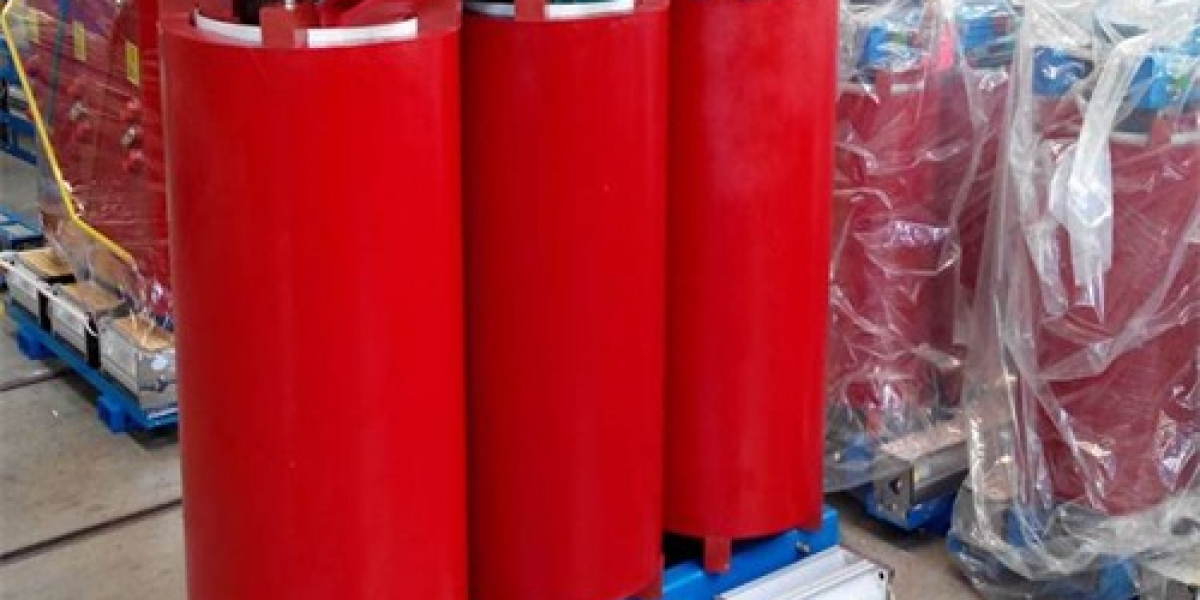

Amorphous alloy describes the core material, not the cooling method — so an amorphous transformer comes in both forms. You can buy a dry-type cast-resin unit (the SCBH family) or an oil-immersed unit (the SH/SBH family). The core cuts no-load losses 70–80% below silicon steel either way; the dry-versus-oil decision comes down to fire risk, site, and budget.
1. The short answer: amorphous is the core, not the coolant
"Amorphous" refers to the metal in the core — a ribbon of iron-boron-silicon alloy cooled so fast it never forms crystals. That ribbon has roughly a third of the magnetic losses of conventional grain-oriented silicon steel. It says nothing about how the windings are cooled. So the question "dry or oil?" has a two-part answer:
- A dry-type amorphous unit (builder codes SCB, SCBH) cools with air and insulates with epoxy.
- An oil-immersed amorphous unit (SH15, SBH15) cools with mineral or ester oil.
Both carry the same low-loss core. Everything else — fire rating, footprint, maintenance, price — follows from the cooling medium.
2. Amorphous dry-type (cast-resin): the SCBH family
This is the air-cooled branch, and it is the one most people picture when they hear "amorphous transformer."
Cooling. Natural air (AN) for normal loading; forced air with fans (AF) when the load or ambient temperature pushes past the AN rating.
Construction. The windings are vacuum-cast in epoxy resin, which seals the whole assembly against moisture, dust, and mold. The low-voltage winding is typically a copper foil layer, which lowers loss and tightens short-circuit strength.
Why teams pick it. No oil means no spill or fire-risk liquid on site, the no-load loss is a fraction of a silicon-steel unit, and the sealed build needs little upkeep across a 20-year-plus service life.
Where it goes. Anywhere fire safety or a hostile environment drives the spec: metro stations, airports, hospitals, high-rise buildings, plus high-humidity, salt-spray, or dusty sites, and temporary setups like construction sites or events that need fast deployment.
Our cast-resin amorphous line, the SCBH15 amorphous alloy dry-type transformer, follows this exact build.
3. Amorphous oil-immersed: the SH/SBH family
The oil-cooled branch trades the fire-safe profile for lower cost and stronger overload behavior.
Cooling. Oil natural (ONAN) for standard duty; forced oil circulation (OFAF) when you need to pull more heat out of the tank.
Construction. A corrugated or plate-radiator tank maximizes surface area, and an on-load tap changer (OLTC) is available to track voltage as the load swings.
Why teams pick it. The manufacturing process is mature, so the unit typically lands 15–20% below the equivalent dry-type on price [Confirm: per supplier quotation]. Oil moves heat better than air, so it handles sustained high load without derating as readily.
Where it goes. Outdoor substations, rural networks, open-pit mines, conventional industrial plants with no special fire requirement, and developing-grid markets such as India and Africa where the cost gap matters most.
The oil-immersed side is covered by the SBH15 amorphous alloy transformer.
4. Dry vs oil, side by side
Attribute | Amorphous dry-type (SCBH) | Amorphous oil-immersed (SH/SBH) |
|---|---|---|
Cooling medium | Air | Transformer oil |
Environmental risk | No oil to leak; cleaner footprint | Oil leak is possible; lower eco rating |
Install location | Indoor / high fire-risk sites | Outdoor / sites with no fire constraint |
First cost | Higher (epoxy, sealed build) | Lower (mature process) |
Maintenance | Near maintenance-free | Periodic oil sampling and testing |
5. How to choose
Lean dry-type when: - You are upgrading an urban network, a commercial building, or a densely populated residential area. - The unit has to be installed or moved quickly — emergency or temporary power, for example.
Lean oil-immersed when: - The budget is tight and the site has no meaningful fire requirement. - The unit runs outdoors or in a remote location for the long haul.
One honest caveat that saves money on big jobs: U.S. distribution-transformer efficiency law (DOE 10 CFR Part 431 Subpart K) covers distribution units, not large power transformers, and oil-immersed distribution transformers are generally capped around 2500 kVA. Past that size, or above roughly 35 kV, a dry-type unit gets expensive fast and oil usually wins on economics. Match the choice to the actual load and site rather than to the "amorphous is always best" line.
Both families are listed across our products page alongside silicon-steel units.
6. The payback math
The savings come almost entirely from the core, not from the cooling side. Amorphous cuts no-load (iron) loss 70–80%; load (copper) loss stays in the normal range. So the unit pays for its premium where it runs lightly loaded or continuously — exactly the profile of a distribution transformer.
A quick check: every 1 kW shaved off no-load loss saves about 8760 kWh a year, worth roughly $1,050 at $0.12/kWh. The source quotes a 3–5 year payback on the dry-type premium once those savings compound. [Confirm: model-specific no-load figures and your local tariff before committing the number.] We cover the broader dry-versus-oil decision across the resources library.
7. Example models
Model | Type | Rating | Core | No-load loss |
|---|---|---|---|---|
SCB18-500 kVA | Dry, cast-resin | 10/0.4 kV | Amorphous | ≤ 1.2 kW [Confirm: per type-test report] |
S13-M-800 kVA | Oil-immersed | 10 kV | Amorphous (as quoted) | ≤ 1.5 kW [Confirm: per type-test report] |
Two localization notes for North American buyers: the 10 kV primary maps to 12.47 or 13.8 kV here, and 0.4 kV secondary maps to 480Y/277 V (600Y/347 V in Canada) — state 60 Hz at the quotation stage, since these units are built for 50 Hz as standard. The "M" suffix means a hermetically sealed tank with no conservator; a sealed unit cannot carry a Buchholz gas relay, so protection relies on a pressure-relief valve and sudden-pressure relay instead. And note that SCB18 "Tier 1" is China's GB 20052 grade 1 — overseas buyers benchmark against DOE and IEEE, not a direct equivalent, so confirm the efficiency grade against the current standard.
A flag on the example: SH15/SBH15 is the amorphous oil-immersed designation. An S13-M is conventionally a silicon-steel unit, so the example's "amorphous core" label should be confirmed with the manufacturer.
These units show up on real jobs in our projects archive.
8. FAQ
Is an amorphous transformer dry-type or oil-immersed?
Both. "Amorphous" is the core material; cooling is separate. You get air-cooled cast-resin units (SCBH) and oil-cooled units (SH/SBH) with the same low-loss core.
How much energy does amorphous actually save?
Roughly 70–80% on no-load loss versus a silicon-steel core. Load loss is about the same, so the savings show up most on lightly loaded or continuously running units — the typical distribution profile.
Is the premium worth it?
Usually, on payback. With no-load loss down 70–80%, the source quotes 3–5 years to recover the dry-type premium through energy savings. It pays back fastest where the transformer sits at partial load most of the time. [Confirm the figure against your tariff and load factor.]
Do amorphous dry-type units need a fire suppression system?
There is no flammable liquid, and the epoxy is fire-retardant, but "fire-retardant" is not "fire-proof." Local codes and the occupancy still decide whether suppression is required — check with the AHJ rather than assuming the transformer alone satisfies the fire rating.
Are amorphous cores noisy?
They can run a few decibels louder than a silicon-steel core because the ribbon is mechanically different. In a noise-sensitive space (hospital, school, residence), the practical fix is vibration isolation pads and an enclosure, often cheaper than chasing a quieter core.
Can I get amorphous transformers in North American voltages?
Yes, but specify it. The Asian-standard 10 kV primary becomes 12.47 or 13.8 kV here and 0.4 kV secondary becomes 480Y/277 V. Also state 60 Hz at quotation — these are built for 50 Hz unless you ask otherwise.
Does DOE efficiency regulation cover amorphous distribution transformers?
The U.S. rule is 10 CFR Part 431 Subpart K: §431.196 for low-voltage dry-type and §431.197 for liquid-immersed distribution transformers. It covers distribution units only; large power transformers above the size limit fall outside it and are governed by contract, not by that regulation.
Which one should I specify for a hospital or high-rise?
Dry-type. With no oil on site, it fits the fire-safety and indoor-installation requirements those buildings carry, and the sealed cast-resin build handles the HVAC-heavy, continuously loaded profile well.